|
The Known History of "Quarter Shrinking"
Updated 09/10/17
A Brief History of High Power
Pulsed Magnetic Fields and Electromagnetic Forming ("magneforming")
Russian
Nobel Prize winning physicist Pyotr L. Kapitza was the first researcher to generate
and study the effects of pulsed ultra-strong magnetic fields. Kapitza
began his magnetic field research in 1924, initially using specially
designed lead-acid storage
batteries as high-current power sources. He combined these with a custom
high-current switch and
fuse arrangement to briefly apply huge currents (10,000+ Amperes) into
robust wire coils (called solenoids). Using this arrangement, Kapitza was able to briefly generate magnetic fields of up to 500,000 Gauss (50 Tesla)
for 3 milliseconds. In later
work, he employed specially designed combinations of flywheels and dynamos
and,
ultimately, banks of high voltage capacitors
to develop even higher
fields
for even shorter intervals. In earlier experiments, huge currents were
briefly forced into solenoids from a powerful source of electrical
energy which was then
disconnected
before the coil could overheat and melt. However,
his attempts to achieve fields greater than 300 kilogauss always
resulted in violent explosions of the solenoids due to extreme magnetic forces acting on the wire turns of the solenoid ("magnetic pressure" and Lorentz force). At 500 kilogauss, the energy density of the magnetic field inside the coil becomes comparable to that of a high explosive, and forces on the coil exceed the tensile strength of even the strongest metals or alloys.
The first laboratory application that used a capacitor
discharge to reshape metal pieces (electromagnetic forming) is credited to T. F.
Wall in 1926. Wall was able to create fields exceeding 450 kilogauss by
using heavily-built work coils that subsequently exploded (after the forming action had completed). In the mid 1950's, Harold
Furth and Ralph Waniek at the Harvard Cyclotron Laboratory developed special
coil construction techniques which permitted electromagnets to survive the
intense forces associated with pulsed ultra-strong magnetic fields. In
the late 1950 s these techniques were first applied on an experimental basis
in industry. US Patent #2,976,907, issued to G. F. Harvey and D. F. Brower (General Dynamics Corp.),
covers the basic process, which is sometimes called Magnetic Pulse Forming
or Magneforming . A. P. Langlois reported on electromagnetic forming
using expendable wire coils to expand or reduce ("swage") tubular parts in 1960. Gulf General
Atomic introduced the first commercially available magnetic metal forming
equipment in 1962. This machine had a capacity of 4,500 foot-pounds ( about
6,100 joules per shot), and could cycle at 10 shots/minute. A number
of other aerospace and capacitor manufacturers further evolved the technology,
increasing the power levels during the 1970 s and 80 s. These included McDonnell
Douglas, Boeing, LTV Aerospace, Advanced Kinetics, Inc., Republic Aviation,
and General Dynamics, and capacitor manufacturers Maxwell, Cornell Dubilier,
and Aerovox. Energy levels were eventually boosted to over 230,000 Joules/shot
in the largest capacitor discharge machines.
Most of the above
activities were
pretty much hidden from the general public. However, one notable exception
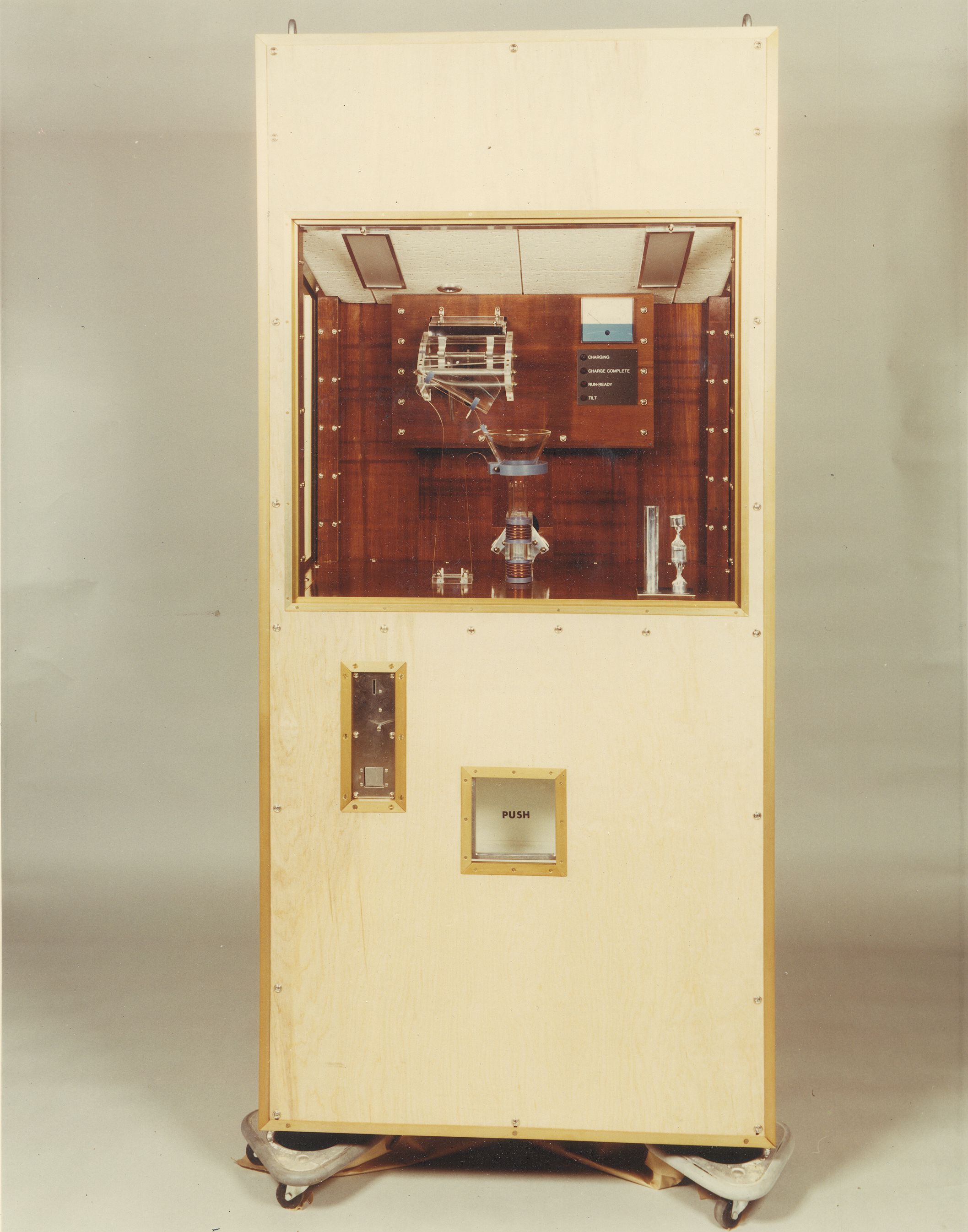
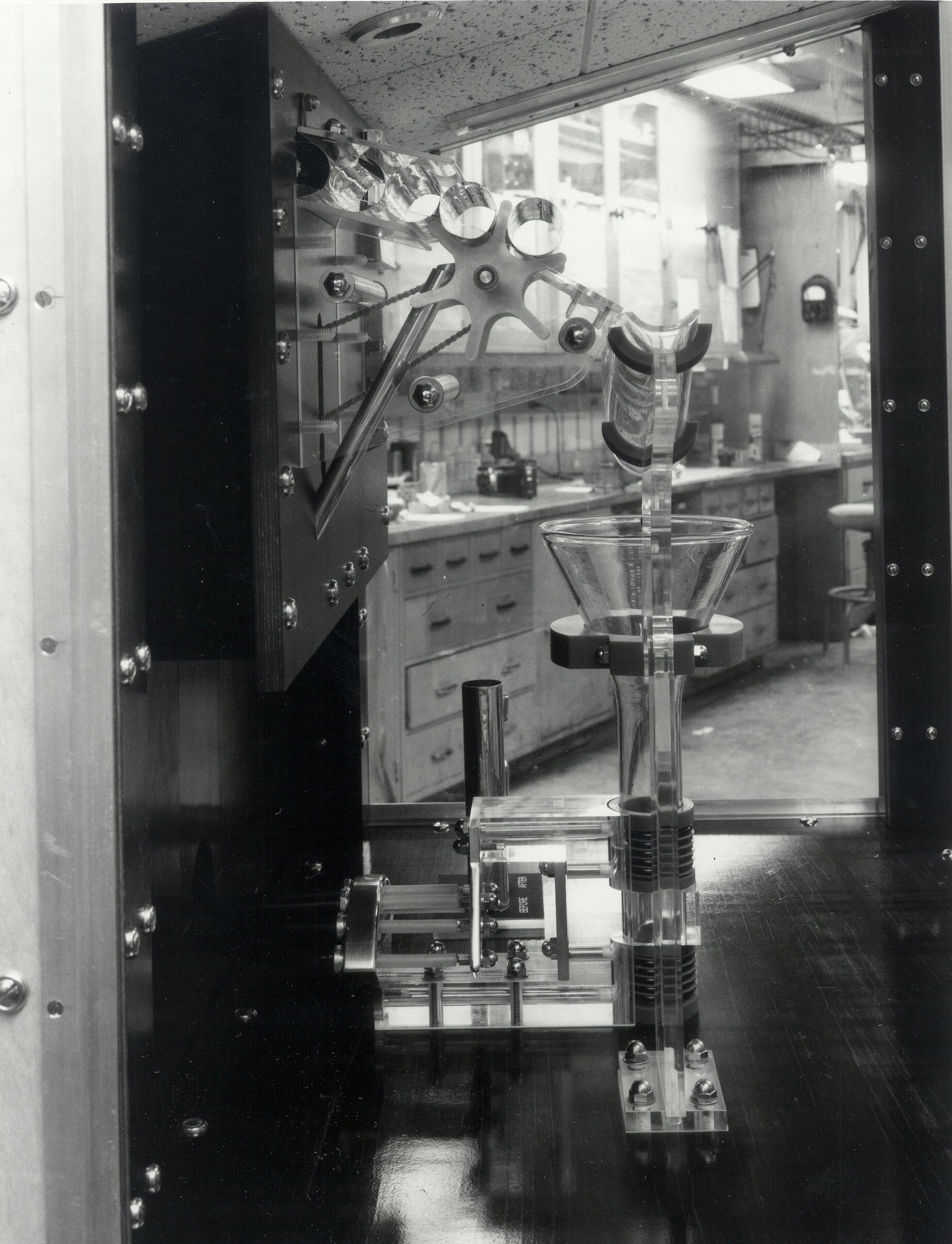
was a special, custom-made "vending machine" that resided within the Smithsonian
during the early 1970's. This machine was actually designed and
built by a group of scientists at Los Alamos National Laboratories. It
was used to
demonstrate the principles of the magnetic "Pinch Effect" to squeeze plasma for
controlled thermonuclear fusion experiments. A hollow aluminum tube was
substituted for plasma since the basic principles are the same. When a
visitor dropped a quarter into the
machine, a mechanism would drop a 1" diameter aluminum tube inside a
pair of heavy-duty work coils. The coils were then briefly pulsed by a
high voltage capacitor
discharge. The resulting pulsed magnetic field instantly necked down
the sections of tubing that were directly inside the coils, causing
these sections to assume hourglass shapes. All of the operations
could be safely observed through the clear front and sides of the
machine. After collapsing the tube, the machine then delivered the
(still warm!) tube
to the visitor as a souvenir.
The History of
"Quarter Shrinking"
It's
not exactly clear just when electromagnetic forming was first applied
to shrink coins. I first learned about "quarter shrinking" via a posting by
Richard Hull (Tesla Coil Builders of Richmond, VA or TCBOR) on the Tesla Coil
Builders Mailing List in 1996. Richard described a videotape of coin crushing
made by Dr. James Goss at Central Alabama College, where James was a
professor of Electrical and Electronics Engineering. On the tape, Dr. Goss
performed various
coin crushing experiments in a system that used a bank of four 15 uF
utility Power Factor Correction
(PFC) capacitors. He constructed a special high voltage switch from a
pair of massive
graphite anodes (removed from special purpose electron tubes called ignitrons).
A
small cannon ball was rolled down a PVC pipe to in order to
bridge the
connection between the graphite electrodes, discharging the capacitor
bank
into the work coil! Although his experiments were temporarily
stalled when one of
the capacitors failed, splitting its case, the remaining three
capacitors are still in use in his coin shrinker today.
Unfortunately, most
high voltage capacitors are simply not designed
to handle the huge magnetic forces and mechanical shocks associated with
the high
discharge currents used in magneforming. Poorly-designed capacitors
can progressively tear themselves
apart during each discharge. Voltage reversals can also cause the
insulating oil and dielectric material inside the capacitor to break down,
liberating gases which begin bulging the metal case. Continued use (abuse?) can cause
the case to rupture or a high voltage insulator to be blown out of the case. And, when one of the
capacitors
abruptly shorts out, it may explode when the other capacitors in the bank
suddenly dump all their stored energy into the failing capacitor.
About a year later (1997), I was fortunate to acquire a
batch of 54 uF 15 kV GE pulse capacitors on the surplus market.
These were metal-cased beauties with big "Frankenstein's lab"
insulators. Each capacitor weighed about 150
pounds - a veritable mad scientist treasure! I cobbled three of these
in parallel, along with a
HV power supply and a triggered
spark gap (made by fellow Tesla coiler Rob Stephens from near Ontario,
Canada), to
build a combination can and quarter shrinker in early 1998. It worked!! However,
unbeknownst to me, the high voltage capacitors suffered from
progressive flexing and weakening of the internal
capacitor buses from magnetic forces during each shot. This quickly lead to
catastrophic capacitor failures after only a few dozen shots.
One particularly destructive failure at
8500 Joules ruptured the steel case of one of the capacitors, allowing it to
disgorge a few of gallons of foul-smelling, blackened oil and tinsel-like aluminum foil
fragments which proceeded to dribble onto the indoor-outdoor carpeting
in the
lab! Needless to say, the wife was NOT
amused by these events!
Upon autopsy, I was able to determine that these "pulse caps" were
internally constructed as Power Factor Correction (PFC) capacitors. It became obvious that they
could not withstand the high-currents and electromagnetic forces
involved with quarter shrinking.
After a long search, I was finally able
to locate a batch of reasonably-priced and very robust Maxwell 70 uF 12,000 volt energy discharge capacitors
through eBay. Dr. John Gudenas (another local high voltage experimenter) and I drove to central Ohio to pick up eleven
of these monsters - 1700 pounds of mad scientist heaven! Each capacitor is rated for 100,000 Amperes per shot for 300,000
shots(!). They have since proven to be the Timex's of pulse capacitors
- they take a lickin' and just keep on tickin'. A pair of these caps
has successfully completed over 7,500 shots with nary a whimper.
In 1998, another local high voltage researcher mentioned an article
written by Gary Hawkins ("Electromagnetic Z-Pinch: Exploring the Nature of
Electromagnetism in High-Energy Capacitor Discharges") that appeared in a
1993 issue of "Extraordinary Science" magazine. In the article, Gary described using a
high voltage x-ray power supply and a 60 kV capacitor bank to launch
rings and plates,
and later on, to crush coins. The article also contained a picture of a
series of coins he'd shrunk using coils with different numbers of turns
at varying
power levels. Until
2001, this was all that I knew of the brief history of coin crushing.
However, a subsequent conversation with science experimenter Bill Beaty
revealed that Quarter
Shrinking was apparently discovered in 1991...
Bill Beaty s fascinating account of what is believed to be the first "Quarter Shrinker"
"Dale
Travous is a sculptor who once had a
big studio space in downtown Seattle, and was making Tesla coils (and
later
a big Tesla Magnifier.) He traded some equipment for some big
caps
around 1990 or so. I think they were 150 kV, maybe 10 uF, six of
them. He was charging them up and using them to destroy pieces of
wire, and I told him about an article I'd seen in the 1970s about an
"optical
shutter" made from a coil of copper rod wound around a soup can with
the
ends removed. When a big laser energy storage capacitor was
discharged
through the coil, the soup can would instantly neck down to close the
aperture." [NOTE: A Sandia scientist has recently forwarded a picture
of the device, invented by Art Van Hook and Gene Neau, and pictured in
the Aug 2, 1974 issue of Sandia's "Lab News". The Sandia article
indicates that they used beer cans, not soup cans, and the researchers
DO look a bit mellow in the image.].
"He tried this on copper pipe and was making
hourglass effects (even shredding very thick 0.75" pipe when the necked-down
part would *bounce*.) Then he found that he could distort a penny
with a very thick coil from a 500-amp circuit breaker. Then he found
that he could smoothly shrink pennies to less that 50% of their original
diameter, but the coil would be destroyed after a few shots. Then
he started using coils made from #10 solid copper wire. Eventually
he tried lots of other coins, and settled on using quarters (they were
a bit more impressive than pennies or $.50 coins for some reason.)
I'm pretty sure this was all in 1991. "
"We found more big caps at Boeing Surplus.
Boeing uses them as dent-pullers. I saw what was probably the dent-puller
power supply at auction, a huge thing the size of several refrigerators
with a bunch of big energy storage caps in parallel within. We learned
that many manufacturers also use capacitor discharges to crimp the metal
fittings onto the ends of rubber hoses."
"Gary Hawkins was a co-renter of the lab space,
and he sent an article to the International Tesla Society about the "Quarter
Shrinker" cap bank. They published it in their magazine, see EXTRAORDINARY
SCIENCE, Volume 5 No.3, summer 1993, p10. This magazine was a publication
of the International Tesla Society, Colorado Springs, CO - the group is
now defunct. Email the author at ghawk@eskimo.com, or https://www.eskimo.com/~ghawk
Others who built later Quarter Shrinkers probably saw this article, or
heard about it second-hand."
"Around 1994 or 1995 Dale Travous had some
pieces in an art exhibit at Seattle COCA gallery. One was a series
of about twenty progressively shrunken quarters mounted in a row on a piece
of white Plexiglas. At the same time he stopped shrinking coins and
instead was using the cap bank attached to a steel "watergun", a short
stubby cannon which could explode a cubic centimeter of water and drive a plastic slug
through a 12" block of clay. Big fun. Later he entered the
cap bank in the "science fair" put on by THE STRANGER adult newspaper.
It was a room-freshener. He was vaporizing cherries, strawberries,
etc. An immense blast like a shotgun going off, and then the room smells
nice."
"Around the same time we got some 100 uF 30
kV Maxwell capacitors free after a government auction, and built a second
quarter shrinker. Lots of people in the Seattle area have coins which
were crushed by this version. Around 1995 I downloaded Mozilla and found
eskimo.com, and posted the article on my beastie that mentioned the quarter
shrinker, https://amasci.com/amateur/capexpt.html.
Much later I added photos of the original capacitor bank. The photos is
still there near the top of the article - go see! All the lab space is
long gone, and the cap banks have been in storage since 1996 or so."
A smell of burning fills the startled air - the electrician is no longer there!
- Hilaire Belloc 1870-1953
| If you are aware
of any earlier history, please let me know! |
References:
- Frank W. Wilson, High Velocity Forming
of Metals , ASTME, Prentice-Hall, 1964
- E. J. Bruno, editor, High Velocity Forming of
Metals Revised Edition, ASTME, 1968
- T. F. Wall, "Generation of Intense Magnetic Fields", Journal of Institution of Electrical
Engineers, 64, 1926, pp 745-757
- H. P. Furth, R. W. Waniek, "Production and Use of High Transient
Magnetic Fields, Part 1 of 2", Review of Scientific Instruments, Volume
27, Issue 5, pp. 195 - 203, April, 1956
- H. P. Furth, M. A. Levine, R. W. Waniek, "Production and Use
of High Transient Magnetic Fields, Part 2 of 2", Review of Scientific
Instruments, Volume 28, Issue 11, pp. 949 - 958, November, 1957
- Noland, M. C., Gadberry, H. M., et al, "High-Velocity Metalworking, a Survey", NASA, 1967
- A. P. Langlois, "Metal Forming with Electromagnetics",
ASTME Creative Manufacturing Seminars, Paper SP60-170, 1960
- D. ter Haar, editor, Collected Papers of P.
L. Kapitza , Volume 1, 1916-1934", Macmillan Co., 1964
- Hawkins, Gary, "Electromagnetic Z-Pinch: Exploring the Nature of Electromagnetism in High-Energy Capacitor Discharges", Extraordinary Science Magazine, Jul-Sept 1993, Volume 5, Number 3.
- William J. Beaty, Usenet and private email correspondence, 12/19/01
Some Other Places to Visit:

|

|
|

|

|
Tesla Info Center
|
"Quarter Shrinker"
|
BIG Arcs & Sparks
|
Get Shrunken Coins
|
Get Lichtenberg Figures |
Back to Stoneridge Engineering LLC Home

|
|